Usually it begins in the same manner. You pull over for the night and grab something to eat and open up your phone “just to check tomorrow’s loads.” But then it’s 2AM in a truck stop your food is now cold and you are still refreshing load boards instead of sleeping. Sound familiar?
You’re tired so tired and your mind won’t shut down – because you’re not just driving. You’re dispatching, negotiating rates, routing, taking broker calls, chasing documents, tracking HOS, and trying to put on a trucking business all by yourself. By the time morning arrives, you feel like you did not get any rest at all.
And that’s when another problem appears – the feeling that you’re falling behind. While you’re digging domestic bulk into load boards, somebody else already booked the run you wanted to run. As you’re stuck behind reams of paper, a sole trader is reclaiming a new rate.
If the signs below seem all too familiar, this isn’t a case of burnout – this is dispatch overload and it’s eating away at your time, your rest, and your earnings.

1. Load Board “Quick Checks” Turn Into Hours of Lost Time
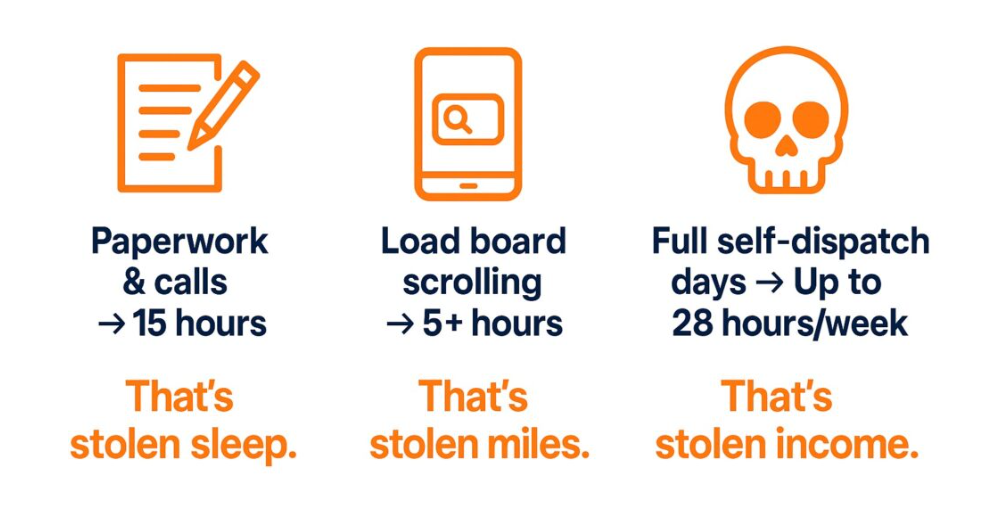
Even outside of the late-night grind, self-dispatch has a knack for swallowing up your downtime. You sit down for a breath of air, or try somehow to catch your breath in the course of the day – suddenly you’re right back in the load board rabbit hole, comparing the rate and replying to messages.
You didn’t intend to spend your leisure time working. It just happens.
But when breaks and off-hours are all too often transitioning to dispatch shifts, you’re losing the one time of day to recover. That’s when exhaustion snowballs – and when self-dispatch problems are beginning to affect your actual driving.
2. Paperwork Slips Through the Cracks
A missed rate con here. An unpaid invoice is there. One document that you swore to have sent but did not?
When you are juggling driving and admin work by yourself, little mistakes become big delays – and often lost loads. Paperwork is one of the biggest owner-operator dispatch challenges, and when it gets ahead of you faster than you can get in front of it, then you’re no longer running the business; the business is running you.
3. You Wake Up Tired No Matter How Long You Sleep
Most drivers are aware of physical fatigue. Dispatch fatigue affects people in a different way. It lingers even after you have one night off – the kind of night when your brain isn’t just on vacation, the kind where you stop work when you’re parked.
Long weeks, short nights, always deciding. On top of this add dispatching, and your body begins waving the red flag. When rest stops working, your workload has gone over the edge of “busy” into the unsustainable zone.
4. Your Home Time Gets Eaten by Dispatch Tasks
Drivers already sacrifice time at home – this is part of trucking. But when you’re constantly answering brokers, away smoking the scanner doc, planning loads, or trying to solve a problem when during that time you should be out and about with your family, that’s when exhaustion hits deeper.
Over half of drivers receive less than 24 hours of time at home a week. If dispatch work chews up even that small window, burnout and dispatch overload don’t stand too far off.
5. You’re Missing Deadlines or Cutting Compliance Close
Not, of course, because you’re careless – but because you’re overloaded.
A forgotten permit. A late filing. A route planned too tight. A missed break, triggering an HOS problem.
These are classic indications of dispatch overwhelm. When your attention is divided between driving and admin, small oversights may cost you time, money or a high-paying load.
6. Your Health Habits Fall Apart Without You Realizing It
It starts small. You go without eating to get a job done. You pick up the fastest fast food because dispatch just won’t wait. Breaks get shorter. Stretching disappears. Rest becomes optional.
On the road, these small sacrifices especially add up fast. Low energy translates into irritability. Irritability turns to exhaustion and restlessness. Exhaustion makes all areas of the job more difficult – driving, negotiating, planning loads.
If dispatch has pushed eating, resting, or the basic self-care to the bottom of your list, the workload isn’t just heavy – it’s unhealthy.
7. You Feel Like You’re Running the Whole Operation Alone – Because You Are
Driving already comes with solitude. Self dispatch isolation is another. Suddenly you’re the driver, dispatcher, planner, accountant, negotiator and problem-solver – the whole operation of this company rolled into one.
Many owner-operators will admit they feel nominated for a bad one-day-away measurement; the whole week collapses.
That pressure isn’t due to the fact that you’re doing anything wrong – it’s doing too many things too soon and too often.
No one is supposed to operate a complete dispatch operation singlehandedly.
How to Take Back Control
Identifying the signs for this is the first step. The next thing you need to do is to protect your time, your health, and your earning potential.
One of the biggest changes is allowing yourself some real off-hours again – not “rest when everything is done” but actual breaks where dispatch doesn’t follow you.
Another thing to change is to re-organise work so that it doesn’t transfer into all of your day. Many drivers find immense relief is made through batching administrating tasks, using simple applications for invoicing or scanning, and putting parameters on when they’re “on.”
Here are some of the small changes that make a big difference:
- Batch paperwork instead of spreading it around throughout the day
- Use of simple tools for scanning, invoicing or storing documents
- Establish certain “off limits” hours when work is halted
- Stick to a micro-routine which promotes rest (even 5 minutes counts)
But for many owner-operators, the greatest transition is the aid of one part of the job which consumes most of their time: dispatching.
A good dispatch partner doesn’t take control – they give it back. They replace what taking care of the tasks that distract you from having your eyes on the road, including:
- Load searching and vetting
- Rate negotiations
- Confirmations as well as paperwork
- Route planning and updates
- Broker communication
You remain in charge but you stop running every single department yourself.
Get Your Time and Your Life Back
If these warning signs sound familiar that’s not to say that you’re failing. You’re just getting the burden of two people instead of two.
At Triumphfleet services, we come in and bail you out of having to run the whole business all of the time. We find good quality loads, negotiate great rates, do the paperwork and keep your schedule moving – the nights back to you, the rest back to you, and the miles that actually make money back to you.
You deserve support.
You deserve sleep.
You deserve to drive without getting burnt out.
READY TO RECLAIM YOUR TIME? WE’RE HERE TO HELP.
Conclusion
Self-dispatching provides truckers with freedom, and it has a hidden cost – time, stress, and lost revenue. If you’re experiencing any of the seven warning signs – chaotic scheduling, missed loads, poor negotiation, poor lane planning, endless paperwork, or (simplistically) feeling overwhelmed – it is time to change your strategy.
The smartest owner-operators know when to delegate their back-office pressure and focus on what really needs to be done: to keep the wheels going and the revenue flowing. A reliable dispatch service saves you time, makes you increase your weekly earnings, reduces empty miles, and creates consistency for your business.
You do not have to operate your trucking operation alone. With the proper support, you’re staying in motion, staying lucrative, and staying ahead of the competition – without drowning in self-dispatch again.