
You hit your target rate per mile. You booked what was apparently premium freight. Yet, the monthly settlement is dismal. You get left with the question, “If my CPM was right, then why did my week turn out wrong?”
The truth is, profitability isn’t murdered by low rate loads. It’s assassinated by inefficiency of operations. This is mathematical execution failure, not mathematical failure. You can win all the battles (individual loads) and even lose the war (your weekly profit).
This extends our cost-per-mile analysis in which we determined your true expenses. Knowing your number base. But now, let’s take a look at why that knowledge is not sufficient. While CPM tells you what each mile will earn should it be profitable, this is about why oftentimes these miles grow but do not connect profitably.

The Myth of the “Good Load”
A “good load” is often defined by a single measure—a high rate per mile. This is a very dangerous simplification. A load is only “good” in reference to the load before it and the load after it.
A $3.00/mile load that drops you in a dead freight zone is not a “good” load. It’s a trap.
A really profitable load has three dimensions:
- Rate: The immediate revenue.
- Lane: Where it take you (what the future opportunity is)
- Timing: Picking it up and delivering it.
DAT Solutions data has found the national average deadhead rate often at 20-25%. In other words, this means that for every empty mile, a driver is compensated for four paid miles. The American Transportation Research Institute (ATRI) says inefficient routes can cut the profit margin of a small fleet by 5–10% every year. This can lead to significant financial losses.
The Three Silent Profit Killers
If individual loads are solid, the leak is in how they’re connected.
Killer 1: The Sequence Screw-Up
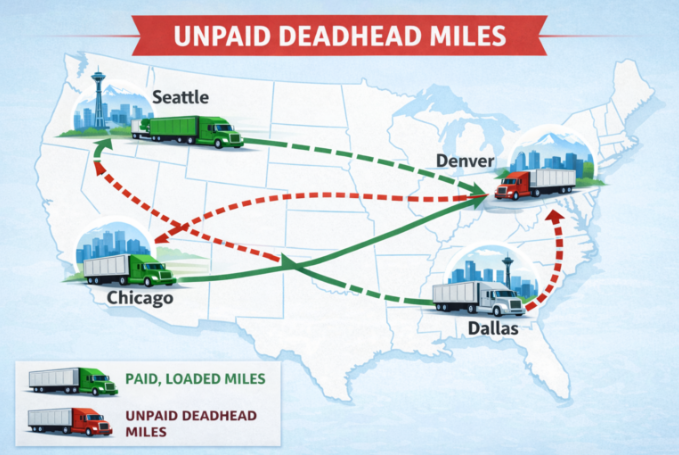
You have three great loads. But if you run them in the wrong order geographically, you’re hemorrhaging money.
The cost of running Chicago -> Atlanta -> Denver -> Seattle -> Dallas -> Chicago creates massive, unpaid deadhead between Atlanta, Denver, and Seattle.
Killer 2: The Timing Trap
A Friday afternoon delivery with no pickup on the weekend A Monday pickup that requires a Sunday evening deadhead. Timing is about as little non-revenue generating time as possible.
The Data: Studies show that poor appointment synchronization can decrease the high utilization of a truck by 15% in a weekly format. You’re leaving money turnover at the dock.
Killer 3: The Lane Decision Disaster
Chasing a premium rate to a weak, outbound market. You get paid to go there, then accept a bottom-dollar load to get out and wipe out your gain.
The Rule: You must think in round-trip revenue—and NOT one-way rate. A $4.00/mile load into a $2.00/mile market is oftentimes worse than a $3.00/mile load into a balanced $2.80/mile market.
Key Stat: Feets lose an estimated $8,000 – $15,000 per truck every year as a result of sequencing and scheduling mistakes that could have been prevented.
The Orchestration Mindset vs. The Load-Finding Mindset
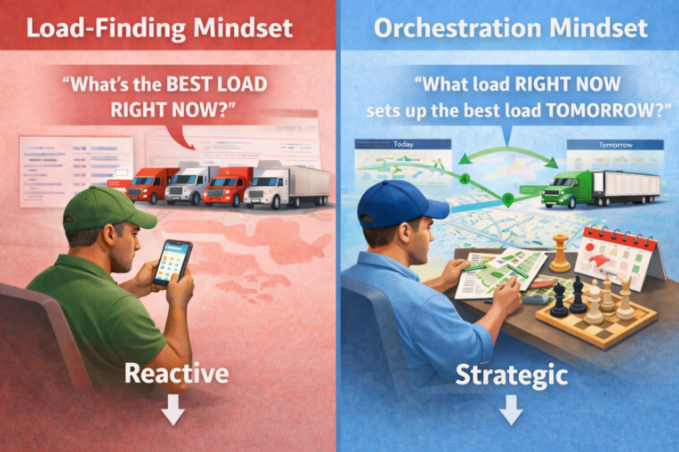
The reactive Load-Finding Mindset poses the question: “What’s the best load that I have available right now?”. It’s transactional.
The proactive orchestration mindset poses the question, “What is the load available to me PRIOR to best setting up the best possible load TOMORROW?” It’s strategic. You are the conductor of your business. Every move sets up the next.
Practical Steps to Diagnose Your Dispatch Patterns
Most operators don’t realize the places where the money leaks until they slow down and look at their week as a whole. These are not complicated tools or software tricks. These are simple habits that encourage you to move away from “load-by-load” thinking and understand how your decisions are interconnected.
The Weekly Map Audit
Once a week, and preferably on the weekend (Sunday), spend 10 min mapping your previous route. In green draw your loaded miles. Draw your empty miles in red.
What is typically presented is not a nice tuned loop, but a tumbling mess of a tangled web of zigzags and backTracking. That visual ‘spaghetti’ is often at first sight the truthful picture of how profit is being quietly inexpensively burned – not on those bad loads, but in between them
The “Next Load” Rule
Hold up one painfully uncomfortable question prior to saying yes to any loan:
“Based on what is currently on the market, what is a realistic option for me after I deliver?”
If you’re not able to name at least one solid follow-up lane then the rate on the load that you have probably isn’t the whole story. This habit alone can prevent you from getting paid well on the way in – and punished on the way out.
Calculate True Cycle CPM
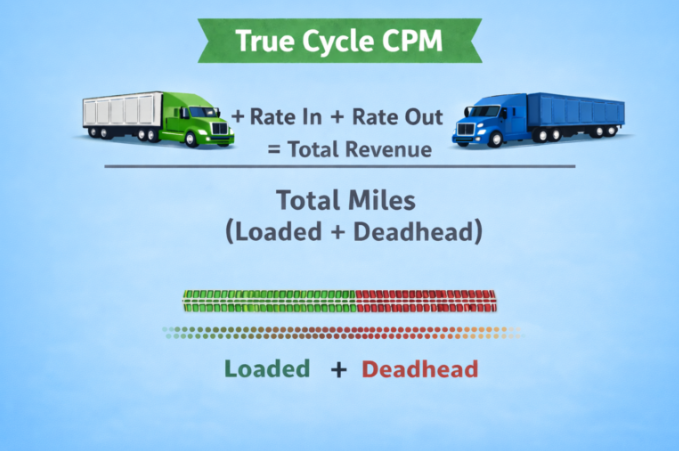
When you are choosing loads, be done thinking in single legs, and begin to think in cycles. For any possible move, there needs to be a quick reality check:
Rate in plus the projected rate out of destination
Total revenue divided by total miles (including both loaded and estimated deadhead miles) gives you this number.
That number—not the headliner rate—is your real number. It’s information indicating if a load contributes to a profitable week or simply is just great to look at by itself.
Conclusion
Understanding your Cost Per Mile provided you with the rulebook. But being a master in the game requires you to think ahead of three steps. Your truck is a revenue generator. The aim is to keep it flowing with as few deadheads (interruptions) as possible.
If this multi-dimensional puzzle sounds like solving a Rubik’s Cube blindfolded, you are not alone. This complexity is what causes many successful operators to eventually outsource planning and load sequencing.
A great dispatch cooperation is responsible for minutes. They think in cycles/revenue streams not transactions.
Your Next Step: What do the Weekly Map Audit—Your Next Step Do? Do the Weekly Map Audit of your last two weeks. If you see a tangled web of deadhead lines upon the life ship problem is clear. The solution is to make the shift from a load-finder to a revenue-stream orchestrator. Your truck—and your bank account—will thank you! This is why the successful operators eventually delegate planning and load sequencing.
👉 Contact Triumph Fleet Services at www.TriumphFleetServices.com or call us at [+1 (682)900-3356]