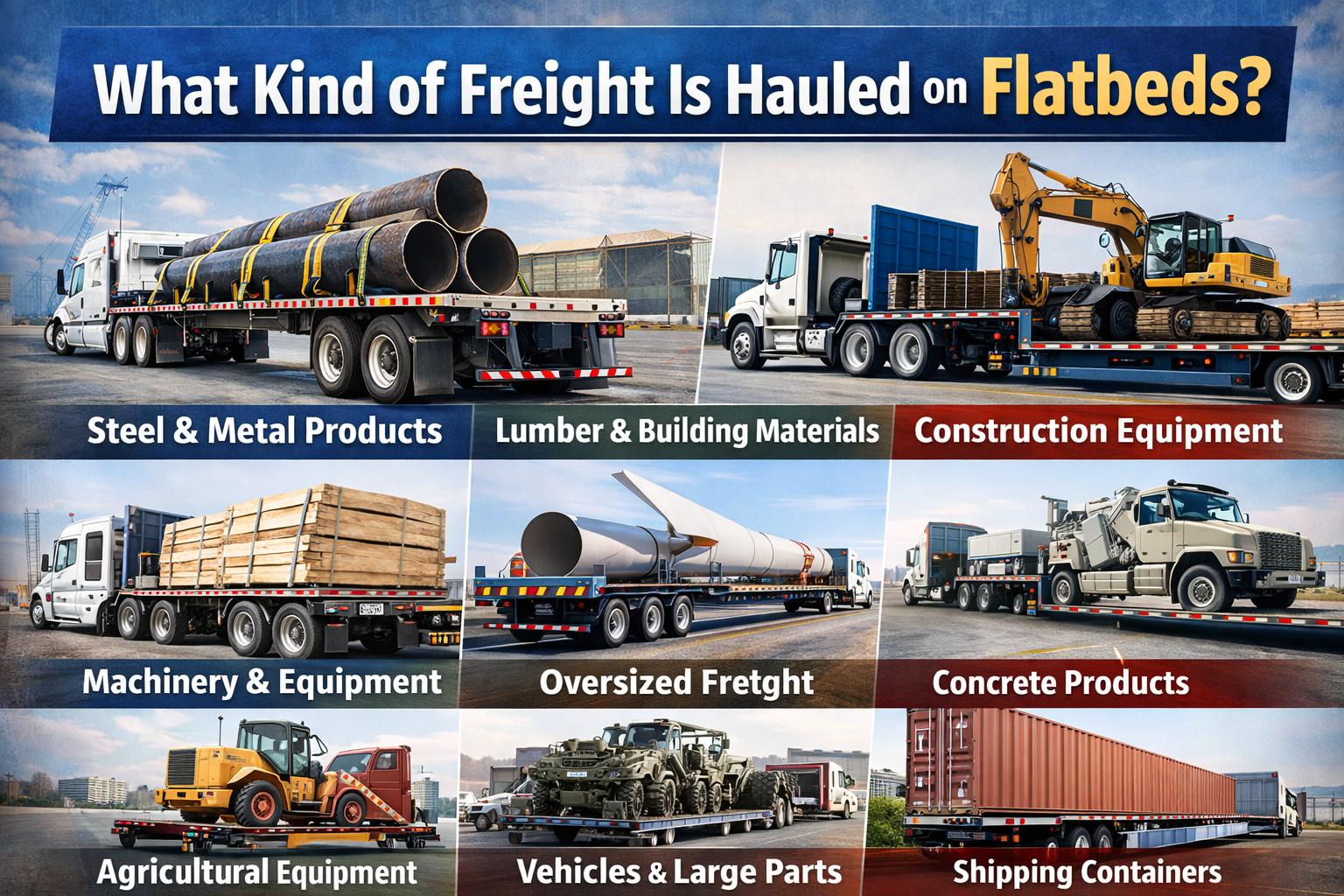
Flatbed trucking – very important for moving big heavy and very oddly shaped items. Unlike covered trailers, flatbed incorporation has an enterolated top area that allows you to put civilization from the top, sides, as well as back. This makes them great for things that do not fit in a normal trailer.
This article discusses what types of cargo are transported by using flatbeds, why flatbeds are used, and how various industries rely on them.
Understanding Flatbed Trailers
A flatbed trailer does not have any walls or top and thus appears like an open deck. This type of design allows it to carry freight that is
- Too wide
- Too tall
- Too heavy.
- Oddly shaped
For flatbed loads, the freight is held in place by straps, chains, binders, or tarps to keep the freight secure and stable during transit.
Why Certain Freight Requires Flatbeds
All freight isn’t boxed, palletized, or enclosed. Flatbed used in case of freight:
- Cannot fit in a dry van
- Needs a crane or side loading.
- Needs special handling
- Is higher in size or height than is standard?
Many industrial and construction goods are dependent on flatbed transport.
Common Types of Freight Hauled on Flatbeds
Steel and Metal Products
Steel is a common flat bed load as it is heavy and has a straight shape.
Examples include:
- Steel coils
- Steel beams and girders
- Metal pipes and tubing
- Sheet metal
- Rebar
These goods are too heavy or too long to be put inside of enclosed trailers and require chains to secure the goods to.
Lumber Materials- Building Materials
Construction materials are typically transported with the use of flatbeds since there are many job sites that lacks loading docks.
Common materials include:
- Lumber
- Plywood
- Drywall
- Roofing materials
- Insulation panels
The flatbeds allow workers to unload the things on site, at the construction site itself.
Construction Equipment
Heavy Equipment is a Bitch of a Flatbed Freight
Examples include:
- Bulldozers
- Skid steers
- Backhoes
- Forklifts
- Excavator attachments
Depending on the size and weight of the load, there may be special flatbed changes that trucks will require, such as step decks and lowboys.
Machinery and Industrial Equipment
Factories and industrial plants make use of flatbeds for the movement of huge machines.
This includes:
- Manufacturing machines
- Industrial compressors
- Generators
- Presses
- Factory equipment
These loads often require special means for retaining the load and weight must be carefully distributed.
Oversize and Over Dimensional Freight
Flatbeds are important to have for very large loads that are larger than the regular limits.
Some examples of oversized freight include:
- Wind turbine parts
- Big tanks
- Pre-made structures
- Industrial silos
These trips require special permits, and possibly must be on or FMCSA.
Concrete and Masonry Products
Concrete items are heavy and hard so flatbeds are the best choice.
Common items include:
- Concrete pipes
- Precast concrete panels
- Blocks and barriers
- Utility vaults
Due to heavy load, securement and axle weight balance is important.
Agriculture Equipment and Supplies
Farmers use flatbeds to move large and odd shaped items.
Examples include:
- Tractors
- Harvesters
- Plows
- Irrigation pipes
- Parts for farming equipment
These loads typically go on to rural areas where the dumping of flatbeds is easier.
Vehicles and Large Parts
Some vehicles and its bigs are carried on flatbeds.
This includes:
- Commercial vehicles
- Military vehicles
- Vehicle frames
- Large engines
- Heavy-duty axles
Flatbeds allow drivers to be more flexible in loading and unloading, especially if a ramp or crane is required.
Shipping Containers
Regular shipping containers get hauled away by flatbed on occasion on short trips.
Uses include:
- Moving from port to yard
- Delivering to the construction sites
- Temporary storage
Containers need to be locked and secure so that they do not move.
Oil Field And Energy Equipment
The energy sector is highly dependent on flatbed trucks.
Some of the common oilfield freight includes:
- Drilling equipment
- Pipes and casings
- Pumps
- Storage tanks
- Energy infrastructure components
These loads are typically heavy in nature and require skilled flatbed drivers.
Flatbud Freight Securement Requirements
Flatbed freight has to be tied down right according to rules. Usually it means:
- * Use straps or chains that are capable of holding the weight
- * Protect the edges
- * Conveyor widths utilizing the right number of tie-downs
- * Check the load at the end of 50 miles of driving
If you don’t secure properly, how you are going to get into accidents, face fines and delays.
Considerations When Moving a Freight on a Flatbed
For flat bed trucks see the weather:
Since flatbed loads are exposed to weather:
- Rain can damage lumber and steel
- Snow and ice increase securement risks
- Wind can affect tarped loads
Tarps are often used to protect freight, but not all cargo requires tarping.
Industries That Are Reliant on Flatbed Freight
Flatbed trucks benefit a number of businesses, such as:
- * Construction
- * Manufacturing
- * Energy and oil & gas
- * Agriculture
- Particulars of drilling: * Infrastructure development
- * Heavy equipment transport
If there were no flatbeds, these businesses would have big problems with goods moving around.
Problems associated with Hauling Flatbed Freight
Flat bed driving is important, but has some problems:
- * Hard work such as putting on tarps and chains
- * More danger for drivers
- * Weather can make work harder
- * More rules to follow
Even so, flatbed jobs usually pay more due to the skill required.
Conclusion
Flatbeds transport items for which not every other truck can be used. From steel, to wood, to heavy machines, and very big loads, flatbed trailers provide the footing of power and flexibility to transport important goods all over the country.
Landing costs to determination of what is brought on flatbeds makes better choices for drivers and dispatchers as well as logistics employees and keeps travel secure and also efficient.
👉 Contact Triumph Fleet Services at www.TriumphFleetServices.com or call us at [+1 (682)900-3356]