OTR, also known as over-the-road trucking, also known as long-haul trucking, is when drivers travel all the way across the country, often all the way across the 48 contiguous states. Distinguished from the regional and local drivers, OTR drivers are a special class of people who spend weeks and even months continuously on the road.
This branch of trucking deals with many types of freight ranging from fresh produce to freight that comes to the United States by way of U.S. ports. Most often, these shipments travel much longer distances, sometimes more than 3,000 miles, with the mean OTR load traveling between 1,200 and 1,400 miles.
OTR drivers work mostly in two modes: work or team work. Solo drivers take about six to seven days to move cargo coast to coast compared to three and a half days for a team. If you are wondering what does OTR mean in trucking, it means over the road which is long haul trucking which goes for very long distances. Let’s Dig In Deep Into What Is OTR Meaning.
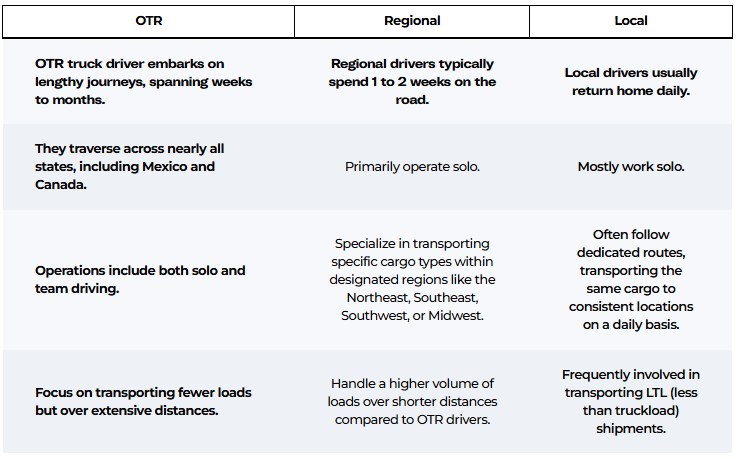
Difference Between OTR, Regional, and Local
Salary Ranges for OTR Truckers
How does the OTR trucker salary rate compare to their regional and local counterparts? Well, it depends on a number of things. Due to the longer routes and the longer time spent on to road, OTR drivers usually earn more than their counterparts. They are generally paid either per mile or a percentage of the line haul money or the total revenue for a load.
Regional drivers who drive shorter routes and have more frequent home time tend to make less money than OTR drivers.
Local drivers are usually paid hourly, which, depending on the company, might lead to much less being earned than OTR and regional drivers. However, drivers who work with specialized cargo such as hazardous materials such as gasoline may earn more than both OTR drivers and regional drivers.
Challenges Faced by OTR Truckers
Transitioning to life as an OTR driver after acquiring all the necessary licenses may seem like the next logical step. However, it’s essential to be aware of the hurdles this career path comes with. Being an OTR trucker requires making a choice to sacrifice time spent at home for several days driving the country’s highways and very often are faced with unfavorable weather conditions, congestion, and limited dining options along the way. Here are some of the noteworthy challenges of OTR truckers:
- Hours of Service (HOS) Rules: Controlled by regulations dating back to the 1930s, HOS rules are strict rules regarding how many hours a driver can drive, to ensure their safety and decrease the effects of fatigue. Compliance requires meeting guidelines like maximum consecutive driving hours, required rest periods and limits of weekly driving hours enforced via electronic logging devices (ELDs) that the U.S. federal government first mandated in December 2019.
- Lengthy Detentions – OTR drivers will often experience delays on load pickups or deliveries that interrupt schedules and can cause delays that may be equally two to two-and-a-half hours or longer.
- Poor Infrastructure: The aging infrastructure of the US poses challenges to drivers of OTR trucks with a significant portion of the roads and bridges showing a degree of deterioration in structure and condition affecting the efficiency and safety of travel.
- High Levels of Stress: The balance of struggling to manage an OTR trucking career as well as a personal life can be mentally taxing and is compounded by factors such as adverse weather, tight deadlines, traffic congestion, and even extended periods away from family.
- Physical Health Issues: The sedentary nature of working in OTR trucking and the use of fast food when away from home for long combined hauls mean that there are health concerns affecting truckers, such as obesity and diabetes, which are more prevalent in truckers than in the rest of the working population in the US.
How Triumphfleet services Can Benefit OTR Truckers?
Well, we got to know the meaning of OTR and its advantages and difficulties. Triumphfleet Services brings a game-changing solution for over-the-road (OTR) truckers that simplifies their operation and boosts their overall efficiency. By making the most out of the dispatching platform growth feature, truckers can enjoy optimized route planning with the lowest idle time and the highest mileage driving. This leads to the advantage of higher earnings potential and lower fuel expenses.
👉 Contact Triumph Fleet Services at www.TriumphFleetServices.com or call us at [+1 (682)900-3356]