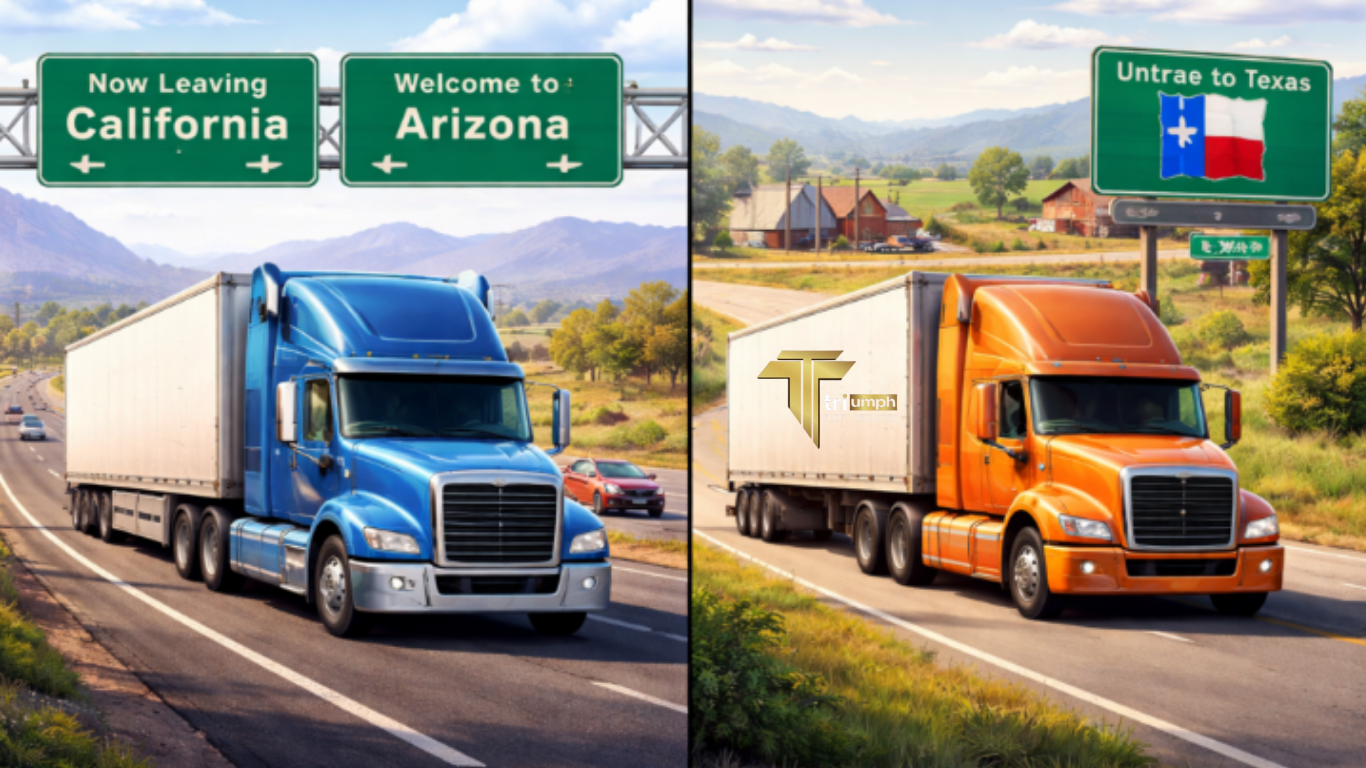
When you are just starting out in the trucking industry, one of the first questions you are likely to encounter is what is the difference between intrastate and interstate trucking?
Intrastate trucking keeps drivers within one state and takes care of deliveries that are close to home. Interstate trucking on the other hand, allows truck drivers to cross state lines, meaning they are covering a longer distance, and their loads may involve freighting goods cross country.

Interstate or Intrastate: The Pittfalls
While the distinction could essentially be described as simple—intrastate means controlling (or interacting with) a specific region within the same state, while interstate passes through state boundaries or national borders—there are a few nuances that can be easily overlooked by many carriers:
- Partial interstate trips count—even if you only transport a portion of a load that is passing through more than one state, then it counts as interstate commerce even if you are never leaving your home state.
- Route efficiency is important: sometimes the cheapest route for a delivery may cross state lines.
- Compliance implications: there are implications of these distinctions when it comes to determining which regulations, permits, and safety rules are required of you on your trip. If you know if a route is interstate or intrastate, it helps to ensure you are not violating the federal and state laws.
Understanding these subtleties is important for drivers to efficiently plan their routes and steer clear of unexpected regulatory issues.
Interstate vs. Intrastate Trucking: The Differences
Interstate and intrastate trucking differ primarily in the scope of their operations and the regulatory frameworks that govern them.
Interstate Trucking
- What it’s about: finding goods: carrying goods across state lines or across international borders.
- Regulations: subject to laws of the US government and overseen by the Federal Motor Carrier Safety Administration (FMCSA).
- Licensing: the drivers need an interstate Commercial Driver’s License (CDL).
- Compliance – must follow federal Hours of Service (HoS) regulations, vehicle weight limits and safety standards.
- Insurance: usually higher insurance costs due to long range, increase of risk
- Equipment: often uses long-haul vehicles e.g. 18-wheelers, flat bed, and refrigerated trailers.
Intrastate Trucking
- What it’s about Transporting goods within a single state (no crossing of state boundaries).
- Regulations: governed by state specific laws which can vary from one state to the other in a considerable fashion.
- Licensing- drivers have the opportunity to operate with an intrastate CDL, which may have requirements different from an interstate CDL.
- Compliance: subject to state level HoS Regulations & Safety Standards which may be less stringent than Federal.
- Insurance Generally lower premiums in result of reduced scope of operations.
- Equipment: uses equipment typically believed to be vehicles, such as box trucks, dump trucks and tow trucks.
Types of Trucks Used for Interstate and Intrastate Trucking
While trucks with the proper licensing can technically operate in both intrastate and interstate routes, certain types of vehicles are more commonly associated with each:
Intrastate Trucking:
These trucks typically handle local or in-state deliveries:
- Box trucks
- Garbage trucks
- Dump trucks
- Concrete mixer trucks
- Bucket trucks
- Tow trucks
Interstate Trucking:
Trucks used for long-haul, cross-state deliveries often include:
- Reefer trucks (refrigerated)
- Tanker trucks
- Flatbed trucks
- Semi-trucks, tractor-trailers, and 18-wheelers
Choosing the right truck type depends on the nature of the freight, the route, and the operational requirements of your business.
Intrastate vs Interstate Trucking: Insurance Requirements
Insurance coverage is an important factor to consider when managing a trucking business and the requirements vary depending on whether you are interstate or intrastate.
Interstate Trucking
For carrier companies operating interstate, minimum public liability insurance standards are set by the Federal Motor Carrier Safety Administration (FMCSA). Coverage amounts depend upon the type of cargo and the car weight move:
- Non-hazardous freight, vehicle under 10,001 lbs: $300,000 min
- Non-hazardous freight, vehicle of more than 10,001 lbs: $750,000 minimum
- Hazardous materials (private or for-hire carriers): $5 m (+ Private vehicle + CA sticker): Minimum $5,000,000
- Oil transportation (private or for-hire carriers): $1,000,000 min
These numbers are the minimum Federal requirements. Many brokers and shippers want at least $1 million of coverage, even for non-hazardous loads, for the fact that they could become the target of litigation for unilateral liability.
Intrastate Trucking
Insurance regulations for in-state operations are determined by the states themselves, and may differ significantly. Some states like California and Colorado have similar guidelines as the FMCSA. Others such as Florida have their own standards, mandating coverage anywhere from $50,000 to $300,000 for non-hazardous freight depending on the weight of the vehicle.
Operating Authority: Interstate vs Intrastate Trucking
An operating authority is very similar to a business license for trucking companies and gives them legal permission to transport freight. Requirements will vary for interstate versus intrastate.
Interstate Trucking
If carriers are going to haul freight across state lines, they will need to get a USDOT number from the US Department of Transportation. In addition, interstate operating authority is required for almost all drivers except those that work within federally designated commercial zones. These zones normally consist of zones near large metropolitan areas that run across state boundaries.
Intrastate Trucking
For in-state operations, no operating authority of the federal government is generally required. However, some 50% of states in the US still require a state-level operating authority for carriers. Regulations do differ from state to state, so it is important to check with the correct state transportation agency to make sure that you are always compliant before beginning intrastate operations.
Unified Carrier Registration (UCR)
Carriers in the interstate trucking industry are required to participate in the Unified Carrier Registration (UCR) program, which is used to fund safety programs and enforcement initiatives throughout the nation.
The process can be a little confusing due to the fact that not all states are participating in the UCR program. Currently 41 states participate in the system. However, even if your home state is not a participant, interstate carriers do have to register to the UCR rules.
Compliance with the UCR guarantees that your business will remain in compliance with the law on an interstate basis and remain free from a penalty or interruption of your interstate business activities.
IFTA Compliance
The International Fuel Tax Agreement (IFTA) and its associated International Registration Plan (IRP) make it easier for carriers working in multiple states to report fuel taxes. Under these agreements, the states get to collect fuel taxes over one carrier license, and there is no need for the states to enact separate fuel permits in each state. Essentially, carriers are only required to file and pay fuel taxes in the state that they live in.
However, several states still require individual intrastate fuel permits, including:
- Connecticut
- Indiana
- Kentucky
- Maine
- North Carolina
- Pennsylvania
- Utah
- West Virginia
For carriers operating within the limits of a single state but who occasionally venture across state lines, temporary fuel and trip permits are an option rather than having to register for IFTA and IRP compliance. This has the advantage of flexibility while keeping the operations legal and without using unnecessary paperwork.
👉 Contact Triumph Fleet Services at www.TriumphFleetServices.com or call us at [+1 (682)900-3356]