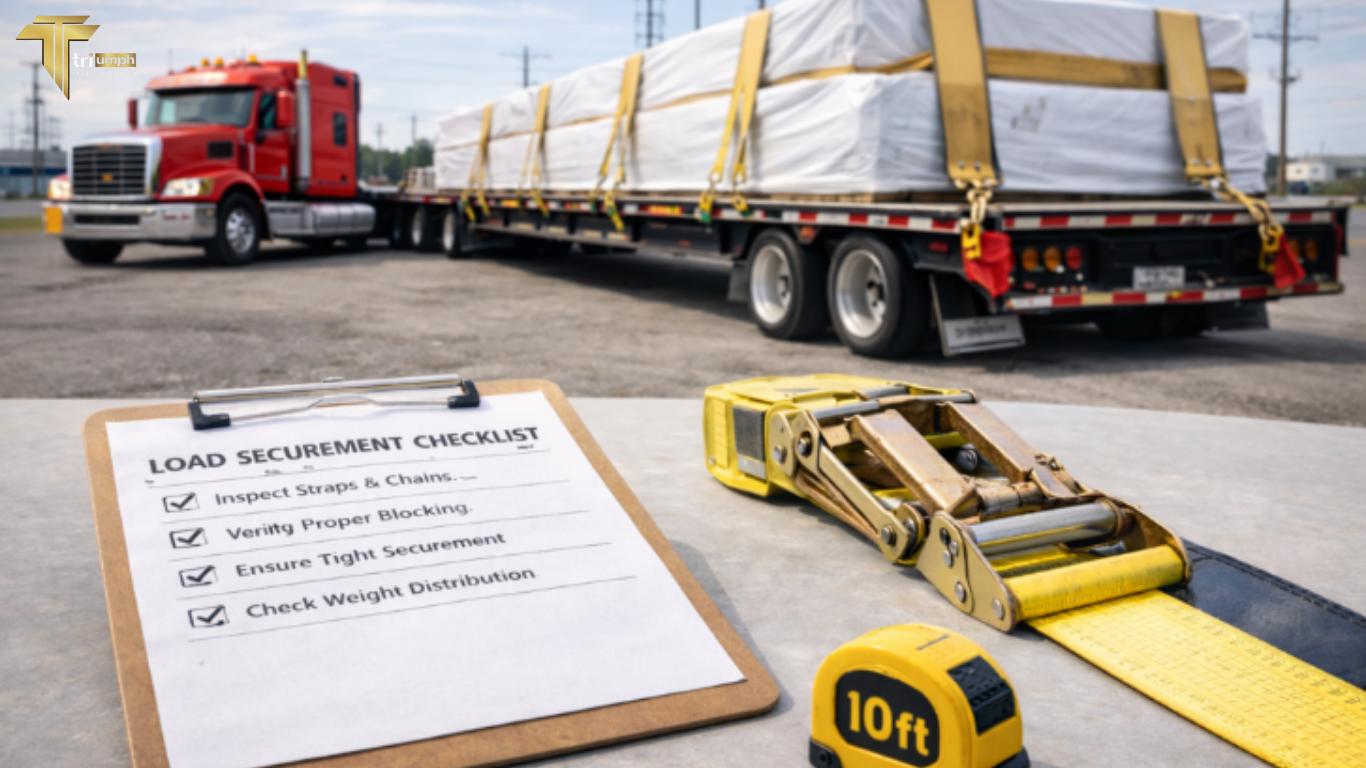
In the world of logistics and transport, flatbed trucking is a very important segment of the industry, as it facilitates the movement of oversized, heavy, or strangely shaped cargo. However, moving freight on a flatbed trailer has its own challenges—and one of the most important issues is keeping the load secure from point A to point B. Improper flatbed load securement isn’t just a safety hazard for the driver and other motorists; it is also a violation of stringent DOT regulations, which can result in costly fines and time delays.
Whether you’re a veteran trucker or getting into the business for the first time, accessing the best practices for securing loads is non-negotiable. In this guide, we’ll examine the fundamentals of flatbed load securement, from using the appropriate tie-downs and binders to stifle shifts in loads to using tarps effectively.

Why Flatbed Load Securement Matters
Flatbed trailers differ from those with enclosures in one very important aspect – there are no walls or a roof to contain the cargo. This means that the responsibility of ensuring the freight stays where it’s supposed to is all on the methods of securement that are used. An improperly secured load can move, fall or even roll over accidents, especially during a sudden stop or a sharp turn.
In addition to the safety risks, there are strict Department of Transportation (DOT) regulations that govern the way that cargo must be tied down on flatbeds. These regulations specify minimum number of tie-downs, working load limitations of securement devices as well as certain rules dependent on the nature and weight of the cargo.
Key Principles of Flatbed Load Securement
1. Understand the working load limit (WLL)
Next, the Working Load Limit, which is the maximum load a securement device (such as a chain, strap, or ratchet) is good for going. When securing a load, a combined WLL of all the tie-downs used must not be less than half the weight of the cargo. This ensures that even in the case of an emergency braking situation, the securement system can keep the freight in place.
Example: If you’re pulling a 10,000 lb piece of machinery, your securement devices must have a total of 5,000 lbs WLL.
2. Know your DOT regulations
According to DOT rules set by FMCSA (Federal Motor Carrier Safety Administration), the securement of cargo is regulated by specific regulations:
- At least four tie-downs must be used for loads more than 10 feet in length.
- One tie-down must be prepared every 10 feet or part of the feet.
- If the cargo is shorter than 5 feet but weighs more than 1,100 lbs, it always requires at least two tie-downs.
Failure to comply may lead to citations, out-of-service orders, and loss of cargo in the event the load shifts or comes loose.
Tools of the Trade: Tie-Downs, Binders, and Tarps
Tie-downs
These are your first line of defenses. Tie-downs consist of chains, webbing straps, and synthetic ropes endemic to a variety of cargo. Before using your tie-downs, always inspect them for wear, fraying, or some damage. Never use a device that has a compromised integrity regardless of how small it may seem.
Ratchet straps are suitable to control a lighter freight or irregular loads.
Steel chains provide no equivalent to strength for heavy-duty applications.
Binders
Binders are used together with chains to apply tension. There are two main types:
- Ratchet binders: Maintain controlled tensioning and are safer to release brakes under load.
- Lever binders: Simpler but more manual and can offer a safety hazard if not released properly.
When using binders, make sure the tension is applied evenly to the load so that the pressure is not uneven and a shift in the load may occur.
Tarps
Tarps have been used to protect cargo from the weather, such as rain, snow, and sun exposure. But they also are useful for the structural integrity of the load during transportation.
There are various types of tarps, such as:
- Lumber tarps: used for protection of lumber or other materials in building.
- Steel tarps: made for flat steel/machinery.
- Machinery tarps: for equipment that is not of a perfectly rectangular shape.
Tarps should be adequately secured to avoid them becoming hazards of their own. A flapping tarp can deteriorate from the wind and possibly have the possibility to come loose.
Best Practices for Securing Loads on a Flatbed
1. Pre-Trip inspection
Before each and every trip, do a thorough inspection of:
- All tie-downs protect binders for signs of wear.
- The load itself—for proper taking and weight distribution
- Trailer deck conditions (clean & dry surface so that it does not move)
2. Load placement
Proper placement of the load will greatly reduce the risk of load shifts. Keep the center of gravity as low and as centered as is possible. Avoid overhanging cargo when it is not absolutely necessary – and follow the overhang securement rules if that is the case.
3. Use edge protection
Sharp edges on cargo may cut into straps and inhibit their effectiveness. Use of edge protectors for ensuring that the cargo and securement devices are not damaged.
4. Secure from all angles
A common mistake is only to secure the load from the sides. Secure from the surface the front, back, and side, especially for tall or odd-shaped loads.
5. Recheck at the end of the first 50 miles.
One of the most important of all the steps in the flatbed load securement process is the first check-in. After driving about 50 miles, stopping, and re-tightening all stopper ties. Vibrations and the road can loosen even the best-secured load.
Common Load Types and Their Securement Tips
Machinery and equipment
Heavy-duty machines need chains as well as ratchet binders. As a minimum, use four tie-downs, making sure to tie down the corners. Watch out for edges that may damage your equipment.
Lumber and building materials
These are prone to load shifts because of their long and narrow shapes. Use lumber tarps and use several tie-downs down the entire length. Consider the use of friction mats under the load to obtain greater stability.
Pipes and cylindrical cargo
Pipes may roll if they are not chocked correctly. Use wedges or cradles in addition to using straps and chains. Make certain that the contact points between the load and trailer are flat.
Stay Ahead: Training and Compliance
Ongoing training is vital. The FMCSA provides some free resources online, and many logistics companies conduct their own internal training on best practices in securement on flatbed loads. Regular refresher courses are held to ensure that drivers remain updated on changing DOT regulations, as well as new equipment options.
Additionally, having load securement software or checklists can help drivers stay organized as well as compliant. Investing in mentorship programs or peer-to-peer learning opportunities can also teach a company to have a stronger safety culture. Veteran drivers have real-world practice with difficult loads and unexpected conditions on the roadway and in the moment, meaning that there is no experience quite like theirs or that it will be lost in the updated ranks. Encouraging knowledge-sharing not only reinforces the fundamentals of securement but this also encourages accountability and teamwork among your fleet.
👉 Contact Triumph Fleet Services at www.TriumphFleetServices.com or call us at [+1 (682)900-3356]