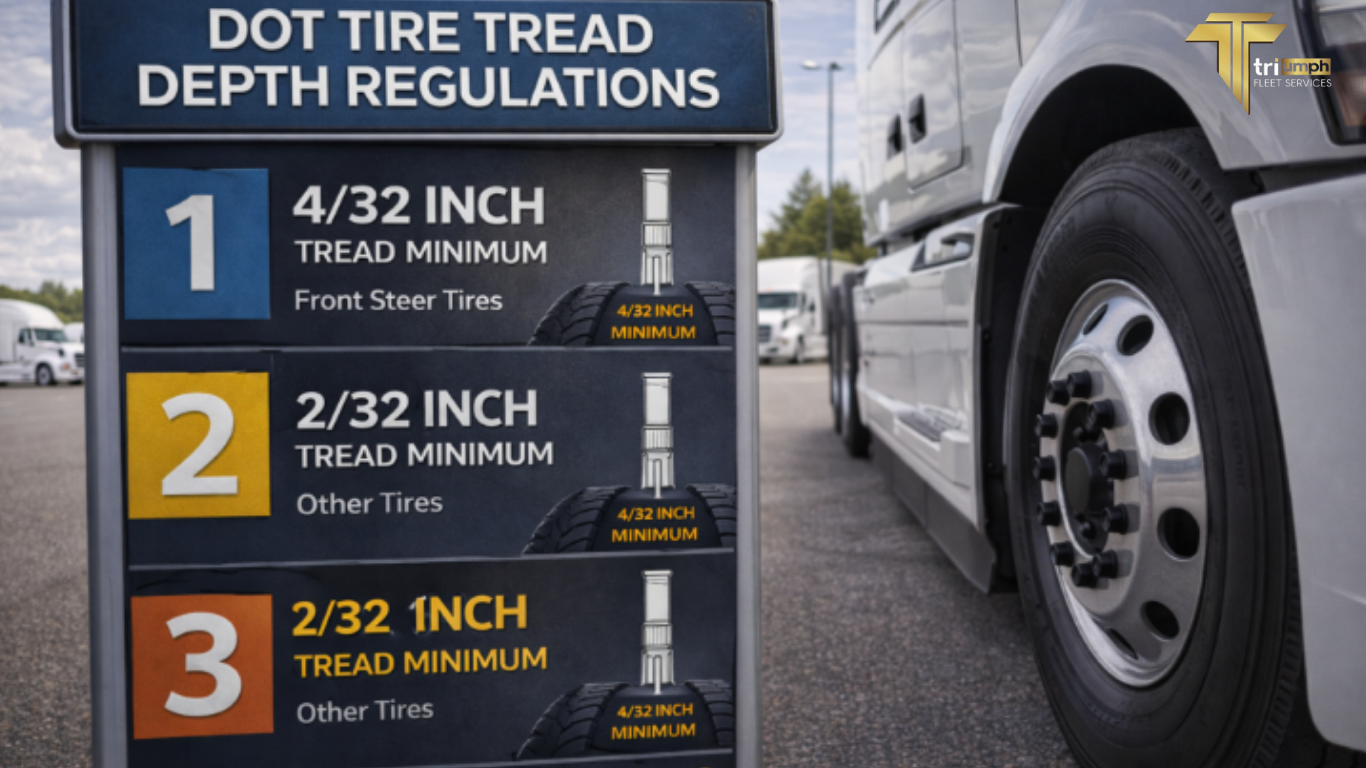
Tire tread depth is an important factor of the trucking safety. It is important to maintain the proper tire tread depth for commercial trucks since this helps increase longevity of a truck and prevents accidents. It can also affect the grip of the vehicle and the strength to brake.
Understanding the importance of tread depth enables to protect the life of drivers and other traffic participants. This is important for trucking business. The regulation authorities prescribe their own tire tread depth standards for commercial vehicles to comply with the safety standards.
The article contains the importance of the tire tread depth, the DOT’ regulations, and practical tips on how you can maintain the compliance of your tires.

What is Tire Tread Depth?
Tire tread depth-The tire tread depth is the factor that is used to mention the safety and the good condition of the tires of a truck. It’s measured by the vertical distance between the top of the rubber tread of a tire to the bottom of the deepest grooves of the tire tread. This is the tire’s capacity to keep the grip and avoid controlling the vehicle.
New tires often measure cone 10/32 or 12/32 of an inch tread. Over time, the depth increases and affects the performance of a vehicle. In particular, it impacts the word of a tire to show water on itself and grip the surface terribly. It causes them to have greater stopping distance and a higher risk of an accident.
There is also a requirement in the trucking industry that the depth of the tire tread be regulated. The Department of Transportation (DOT) sets certain regulations standards for the tire tread depth amounts. Thus, commercial trucks need at least four-8 thirty-second of a tread depth for steer tires and two-8 thirty-second for all other tires.
Regulatory compliance requires the head reading of the tire tread depth on a routine basis. In addition, it’s important to check more than one since, in cases of uneven wear, one side may be more worn than the other. Different factors such as improper tire inflation, tire alignment or unbalanced loads can lead to uneven tire wear.
In addition, sufficient depth of the tread is responsible for the durability of the tires and their performance. Insufficient tread depth can reduce safety information and wear it faster as well as keep replacing it more frequently. This can result in a cost of trucking company significantly.
DOT Tire Tread Depth Regulations
DOT regulations give guidelines for all commercial truck operators to follow. The goal is to guarantee safety on the road. The rules require the minimum tread for the tires of commercial vehicles. This provides adequate traction, stability and safety on the road. Suitable tread depth is especially critical in difficult conditions, e.g. rain, snow, rough terrain, etc.
Importance of DOT Tire Tread Depth Regulations
For several factors, the DOT tire tread depth standards are important. To begin with, tread depth affects the grip of the tire upon the road. Not enough tread can result in increased risks during the driving process, such as hydroplaning and loss of gripping ability, otherwise known as traction. This can be dangerous in the case of trucks because braking distances increase, and stricter control would be required while maneuvering.
The next aspect is making the trucking industry consistent and fair. With a tread depth in place, the DOT makes it an equal playing field for all commercial vehicles. This helps to prevent the operator from cutting corners by using worn-out tires.
DOT tire regulations also encourage the sustainability and profitability of trucking operations. In particular, by keeping the tread depth on truck tires intact, fuel efficiency can be increased, as these tires have a lower rolling resistance. This is cost-saving over time. It’s good for fleets that have long driving distances.
The Consequences of Non-Compliance
Violations of the DOT tire tread depth regulations can result in problems of the most severe kind. The great risk involved is the possibility of accidents. Tires with reduced tread depth may lose traction, which will increase stopping distances and reduce control.
Non-compliance also results in legal or regulatory problems like fines and penalties. If a truck is found to have tires that fail to meet the requirements, it can be placed out of service. For this reason, it isn’t able to keep going with transportation until the tire replacement. This generally leads to delays at the time of delivery or increased maintenance costs. Moreover, it can ruin the company or the driver’s safety score, which is a critical factor in maintaining the contracts and insurance rate.
How to Measure Tire Tread Depth
Measuring tyre tread depth is fundamental in ensuring the compliance with DOT regulations and safety at large on the road. For truck drivers and fleet managers, keeping an eye on itself every day and regularly is the best way to steer clear of the expensive tickets of violations and time delays.
Tools You Need to Measure Tire Tread Depth
In order to make accurate measurements, one needs some reliable tools. The most common tools are that of the tread depth gauge or a simple penny. The tread depth gauge is able to give a more accurate result and are used to often carry out regular inspection for compliance. At the same time, the penny test is a quick and easy way to get an estimate of the condition of your tire.
And failure to accurately measure tread depth can cause an inaccurate measure to be made, leading to potential safety hazards and costly fines and legal issues.
Tread depth gauge
It’s a special measuring tool that is made to measure the depth of the grooves of the tire. Tread depth gauges – not expensive and easy to use. They give reading with precision of 1/32 of an inch.
This tool is extremely important for any person who is involved in operations with commercial vehicles.
The main characteristics of this approach are:
- Precision. A tread depth gauge provides an option of measuring the tire tread depth on the truck with exact precision. Even a slight deviation can have an effect on performance.
- Easiness. The tool has a simple design. Thus, it’s easy for drivers and maintenance personnel to check tread depth on a regular basis.
- Affordability. Tread depth gauges are not expensive. Their low cost and high utility make them a courageous tool for any trucking operations.
- Durability. Most tread depth gauges are designed to last and long with the materials used in their construction. Longevity refers to a single purchase and offers years of reliable service.
- Versatility. As they’re mainly meant for data of the depth of tread, some gauges feature the extra features such as necessitating use to measure tire pressure or the evenness of the tread wear.
Steps to measure the tread depth of your tires:
- Choose the right spot. It is necessary to measure the tread depth in major grooves. Measurements in minor grooves can decrease the accuracy.
- Insert the tread depth gauge. Most importantly, when measuring, one should be careful to place the bottom of the tread depth gauge flat against the tire. Push the measuring pin down so that it touches the bottom Make sure that it’s specific to the tire surface as it’s important in order to take an accurate read.
- Read the measurement. Once the gauge has been placed, turn the reading over on the scale. DOT requires a minimum of 4/32 of an inch for the front tires, for other commercial truck tires a minimum of 2/32 of an inch. If the results are less than these levels, the tire is considered to be in non-compliance.
- Repeat the process. The depth of the tread requires to be measured at different points. Uneven wear can happen for such reasons as improper inflation or uneven weight distribution.
- Record the result. Keep a record on your measurement of the tread depth. It will help you to track the wear of your tire over time, plan the replacement and for compliance during the inspection.
Penny test
This is not a very accurate method. However it is a good way to get an in-depth idea of your tire’s tread depth as soon as possible but it’s also a quick and easy way to get a basic sense of your tire’s tread depth. The test envisions the usage of a penny with Lincoln’s head as the point.
The way is to put the penny in the grove of the tire with Lincoln’s face down. If you find that all of Lincoln’s head visible, you are at 2/32 inches of tread wear or less so that is the minimum of tread wear and is what the DOT requires.
However, it shouldn’t be used instead of regular measurements with a tread depth gage as it doesn’t give accurate measurements.
This is a very common method that does not require any special tools. Its advantages foresee:
- Simplicity. The penny test is the simplest of tests to make in defining your truck tire tread depth. It takes just a penny to get a generated idea on the conditions of your tires.
- Accessibility. Pennies are very common and are easily obtainable. In this respect, the method can be applied everywhere without special tools. It makes the penny test appropriate for quick tests while on the road or in routine inspections.
- Cost-free. The penny test does not cost a thing more than the penny itself. That’s why the method is a popular choice in drivers particularly on the road.
- Quick reference. The penny test gives quick results and the knowledge of whether your tires meet the legal limit or they do not. While it is not an exact measurement it can warn you of potential problems.
Steps to measure the tread depth of your tires:
- Put in a needle (penny in the Butt & Up) Carbon Paper Need a penny to put into the groove of the tire and have Lincoln’s head facing down.
- Assess the tread depth. If you see the entire head of the Lincol’s, then the depth of tread is less than 2/32. Thus, the tire is not meeting the DOT minimum requirement.
DOT Regulations for Different Tire Types
The DOT tire tread depth regulations are a way of ensuring the safety and performance of different types of tires. Different types have certain requirements under the safety standards.
The DOT tire tread depth regulations can differ based on the type of tire, as well as the role of a tire in the operation of the truck. Still, having the proper tread depth on truck tires is necessary in any case to ensure safety and better performance.
Regular inspections, maintenance activities and following the law will guarantee your fleet’s reliability.
Steer Tires
Steer tires are the tires on the front of the commercial truck and have an important significance for steering and handling. Amidst their importance, DOT has higher tire tread depth requirements for these tires.
- Minimum tread depth. The DOT requires steer tires tread in depth to be 4/32 of one inch. It’s mandatory as the front tires have good grip and effort. Better contact with the road – deep tread ensures better contact with the road, particularly in bad weather conditions.
- Inspection frequency. Steer tires should be checked more frequently than the others given the critical role they have. Regular checks are made to ensure that the tread depth is compliant with the laws so as to avoid potential safety hazards.
Drive Tires
Drive tires are on powered axles on the truck. They are responsible for the job of providing traction to move the vehicle. As such, they also have certain DOT tire tread depth requirements.
Minimum tread depth. The DOT requires that the minimum tread depth allow for drive tires to be 2/32 inch. This is less than the standards for steer tires, however, but is also crucial for maintaining traction. Sufficient tread depth to provide adequate grip of the road and prevent wheel spin and provide power transfer from the engine to the road.
- Importance of even wear. Due to the wight distribution, drive tires can have uneven wear. Driver and maintenance personnel can rotate the tires and check the tread depth regularly to ensure that they are in compliance with DOT tire regulations and also extend tires life. Uneven wear may lead to less traction and, hence, a higher chance of skidding.
- Impact on fuel efficiency. It is also true that the correct depth of truck tire treads will help to increase fuel efficiency. This enables better operations and saving on fuel.
Trailer Tires
Trailer tires or free-rolling tires carry a serious percentage of the load of the vehicle. They also have their set of requirements.
- Minimum read depth. According to the DOT regulations, drive tires should have a minimum tread depth of 2/32 of an inch as drive tires. This provides load stability in addition to safe braking. Inadequate tread depth can be a provoking factor in poor handling characteristics, longer stopping and an increase in blow-out risk.
- Load management. Trailer tires are exposed to different loads, depending on the load that is traversed. Adequate commercial truck tire tread depth assists in distributing the load evenly and reducing the chances of the tire failure and enhancing safety at large.
- Regular inspection. Since trailer tires are very often out of the sight of the driver they may be missed in checks. However, regular inspections ensure the compliance to the DOT tire tread depth standards.
Retreated Tires
Retracted tires are found widely on drive and trailer axels. They are recycled using a new tread on a worn tie casing. Thus, for many fleets retreated tires are a cost-effective option.
- Tread depth requirements. Retreated tires must meet the tire tread depth regulations. In particular, they must have the tread depth of 4/32 or 2/32 of an inch depending on its placement.
- Quality issues. While retreated tires are sometimes an economical way to drive, it’s important to do your regards and select provides who comply with all DOT regulations on tire. Poorly retreated tires may cause tires to wear out prematurely, cause separation of the tread in the tire, and result in tire blowouts.
- Usage restrictions. Retracted tires are not usually allowed on the steer axels of commercial trucks. This restriction is a part of the DOT safety standards.
Specialty Tires
Specialty tires are used on off-road vehicles, loads that exceed, or have specialized commercial vehicles. They have different DOT tire regulations, depending on the specific use they have.
- Custom tread patterns. Some specialty tires are made where the tread pattern is custom made for a particular application. This can be for off road traction or yet higher fuel efficiency due to reduced rolling resistance. Still, they are responsible for following the minimum requirements of the DOT’s tire tread depth requirement.
- Regulatory variances. The vehicles exempt from the DOT tire regulations also have variations on the requirement on the type of vehicle and operating conditions. Regular inspections are, however, required in all cases.
Common Issues with Tire Tread and How to Address Them
enzymes, lipid-b Ру Liber B – keeping up with following the protective tires is to do not just folly do the DOT regulation. It’s also aspect that certainly ensures safety and efficiency. However, drivers can cause some common problems on the road. We offer typical problems and advice on regulating them away in order to maintain the very best condition of your tires.
Uneven tread wear
Uneven tread wear is the most common problem that occurs. It can be caused by improper inflation, misalignment or unbalanced wheels. This problem may reduce the life of the tire and result in a non-compliance with DOT standards.
Causes:
- Improper inflation. Under/over inflated tires will wear out unevenly.
- In particular, under-inflation causes quicker wear of the outer edges, while over-inflation causes quicker wearing of a tire’s center.
- Misalignment. Underground wheels cause the uneven thread of the tires. This affects the steer tires most of the time.
- Unbalanced wheels. Unbalanced wheels result in vibration while driving that causes some tire areas to wear down faster.
To address this issue, you can follow the next steps
- Check tire pressure. The proper tire pressure is very important. Remember to check tire pressure on a regular basis to ensure that all the tires are properly inflated.
- Wheel alignment. Schedule and performs regular wheel alignment and balancing clients. This helps to distribute the weight which is applied to the tire surface equally.
- Rotating tires. Rotate tires so that even the wear out. This can help them live longer.
Cupping
Cupping or scalloping – Types of electrical tread Tyler is the type of irregular tread wear pattern as: This is characterized by arising out the high and low points on the surface of the tire. This problem can have ramifications on how the vehicle is handled.
Causes:
- Suspension problems. Worn or damaged suspension parts can cause the tires to bounce around when they are rotated resulting in cupping.
- Unbalanced tires. This can lead to cupping in the middle of the uneven distribution of weight in the tire. You can avoid tires cupping by following the next things:
- Inspect suspension. Examine the suspension system for worn and damaged parts. The components covered by the inspection should include shocks, struts and other components. This will help you to identify the part which is being worn or damaged to avoid cupping.
- Balance tires. Make sure that all tires are balanced, in particular after changing or rotating tires. This helps to distribute the weight evenly.
Feathering
This problem arises when the tread ribs take a sawtooth appearance. It’s caused by the improper weight bearing Toe alignment. Feathering caused may lead to premature tire wear and non-compliance to DOT tire regulations.
The number one reason that feathers on feathers is toe alignment. The tires aren’t oriented towards dead straight. This causes the ribs of the tread to wear unevenly as a result of a feathered pattern.
By following this strategy this issue can be prevented:
- Check alignment. Perform regular checks for zero alignment. Proper toe alignment acts as a way to make sure that the tires are rolling straight, meaning that the tires will undoubtedly suffer from even wear.
- Tire rotation. Regular rotate-tire in order to reduce the effects of feathering.
Tread separation
Having a Tread Separation One of the serious problems is when the tread starts separating from the body of the tire. This can lead to tire failure. In addition, it halts a crucial safety hazard and results in severe penalty for non-adherence of DOT tire regulations.
Causes:
- Manufacturing defects. Tread separation may take place because of manufacturing defects, especially in tires with retread.
- Overloading. Carrying loads above the capacity of the tire can result in immense heat being generated. This leads to the formation of tread separation.
- Punctures or damage. External damage that aren’t repaired properly also in turn can also lead to tread separation.
The following steps may prevent this:
- Monitor the load weighs. Always make sure that the load in the truck is not exceeding the capacity of the tire. Overloading can help cause separation of the treads, which affects the performance of the overall.
- Conduct inspections. Check all truck tires, especially those that recede for signs of separation or damage on a regular basis. Early detection of separation of the tread and making sure that DOT tire tread depth aren’t not removing compliance can be averted by early detection and repair.
- Conduct repairs. Proper repairs of the punctures or damages help in ensuring the safety of the tires. Poorly repairs may cause weak spots and suffering from tread separation.
Additional DOT Tire Regulations
In addition to DOT tire tread depth regulation, the DOT set other extremely important rules for keeping DOT tires safe and their operations running efficiently. These are the DOT tire regulations, which are projected to prevent accidents and promote safety on the roads.
In particular DOT requires drivers to comply with:
- Tire pressure requirements. Maintaining the proper pressure depends on the safety and compliance. Even a minute disruption or violation can cause non uniformity and tire failures. The DOT requires that all tires be inflated to the manufacturer’s recommendations. This helps to ensure the correct commercial truck tire tread depth and ensures the overall performance.
- Tire load ratings. Each tire has its own maximum load rating, which is the maximum amount that it can roll. Having more than this can lead to over-wear, which shortens truck tire tread. The DOT requires that all commercial truck tires be rated for the load they carry. This regulation helps to make sure that the tires do not become overwhelmed by them, as this can kill the safety.
- Retreated tire regulations. Retreading is a common method in the commercial trucking industry because it allows extending the life of tires. The DOT has strict rules regarding their use. Retracted tires are allowed on the drive and trailer vehicle axles, but not on the front steering tires of commercial trucks. This is the reason why this regulation is based on the critical importance of the steering axle for the control of the vehicle.
Conclusion
Having proper tire tread depth is not only an issue of obeying DOT rules. It’s a highly important safety mechanism that helps eliminate accidents and saves money in terms of running costs. Regularly checks of monitor depth and pressure tires can minimize the risk of blowouts, as well as increase the level of vehicle traction, baking ability and overall road safety.
Improper tire tread depth can lead to non-compliance to DOT regulations or such problems as increased stopping distances and reduction of vehicle control. Overtime, it can further lead to more frequent tire changes and increased operations costs.
Regular inspections, proper measurements and timely replacements can bring about huge benefits and lower costs in terms of operations in the long run. Keeping track of your tire tread depth is an investment in safety and positive performance.
👉 Contact Triumph Fleet Services at www.TriumphFleetServices.com or call us at [+1 (682)900-3356]