The trucking industry is dependent on safety and compliance – especially when drivers are running long hours and tight schedules. That’s why we have Hours of Service (HOS) rules to reduce the danger associated with fatigue, as well as to ensure that drivers have enough time to rest in between their shifts.
If you’re a truck driver or owner-operator, you’ve certainly heard about Hours of Service (HOS) – the rules regarding driving ethics, limits of how long you can keep yourself on the wheel at a time and have to take breaks. These limits impact everything from pick up time to drop off windows and it plays a big role in the way you plan your week and protect your income.
The “trucker clock”, a trade name for the hours of service regulations, is a protection against drowsiness and a guarantee of safety on the roads. Truck drivers need to follow these rules in order to avoid accidents caused by being exhausted or unable to stay alert.
In essence, the dot driving hours is referring to the hours of service guidelines of the Department of Transportation (DOT). Shippers and trucking companies need to be familiar with these regulations to ensure that logistics planning is optimized and that they are also compliant with the legal requirements. By knowing how many hours a truck driver can drive within the stipulated timeframes, it can allow stakeholders within the trucking industry to ensure that a balance between operational efficiency and safety on the road can be maintained.
HOS Rules (Quick Summary)
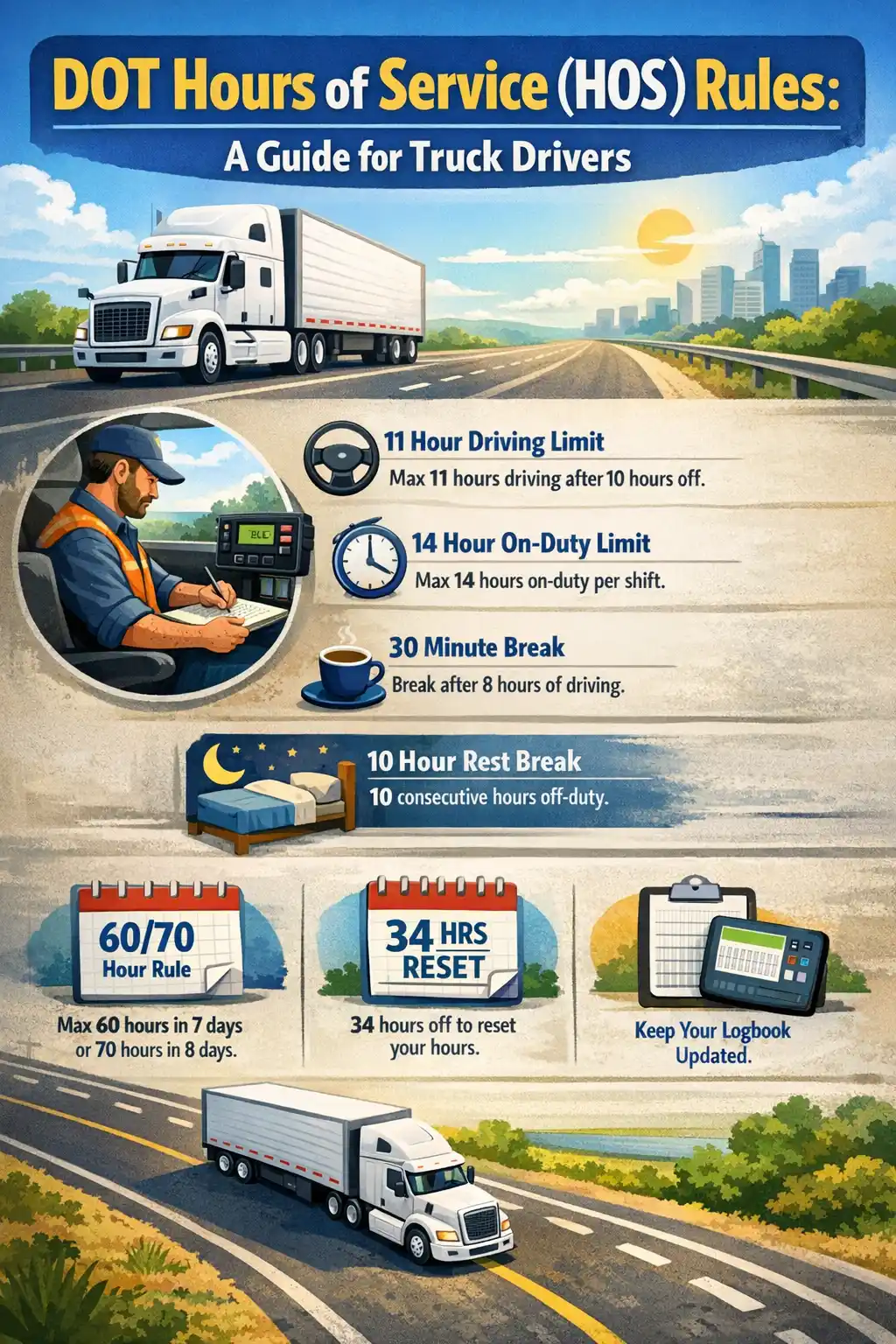
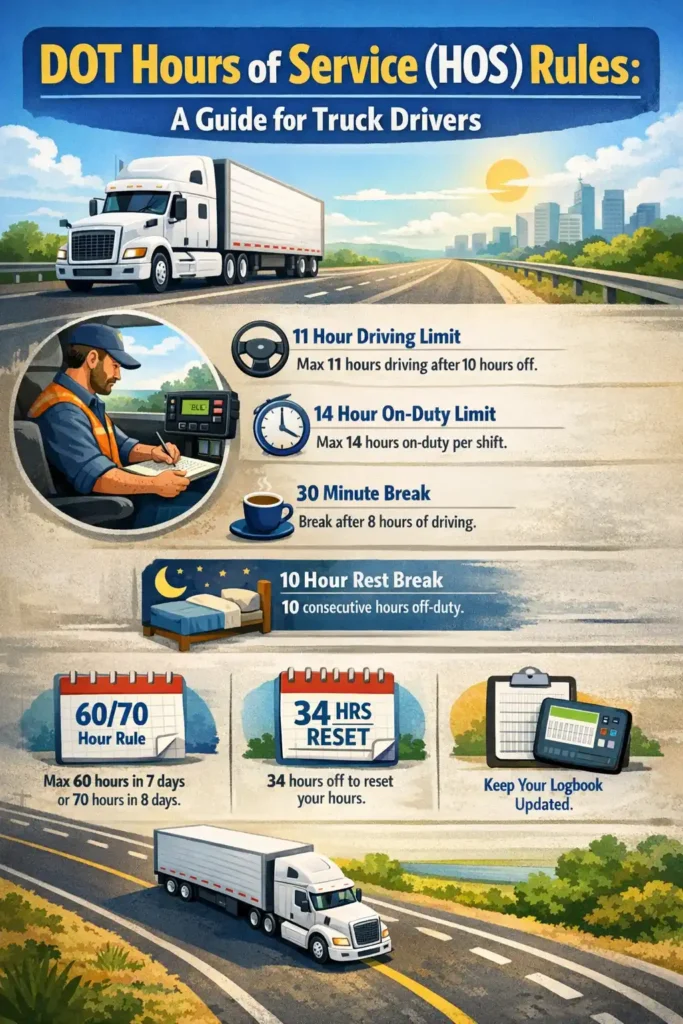
- 11-hour driving limit 11 hours you can drive after 10 consecutive hours off duty
- 14-hour limit: When you can’t drive after starting your 14-hour on-duty window (even if you do not have any more driving time left)
- 30 minute break:Required after 8 hours of driving time (can be on-duty not driving)
- 60/70-hour limit: You can dare not drive after 60 hours in 7 days or 70 hours in 8 days
- 34 hour reset – Taking 34 hours off duty resets your 60/70 redshift clock (unless of course you run recap hours)
What Counts as Hours of Service in the Trucking Industry?
Hours of Service (HOS) is a reference to government regulations regarding the maximum hours that truck drivers can work in one day. These regulations are established by the Federal Motor Carrier Safety Administration (FMCSA), a specialized arm of the US Department of Transportation that is committed to regulating the trucking industry.
Within the framework of their guidelines, the FMCSA uses Hours of Service to regulate different aspects of a driver’s daily schedule including:
- Total amount of drive time
- Quantity and duration of breaks
The FMCSA’s HOS regulations for the amount of time a driver is allowed to drive in a day are outlined as follows:
- 11-Hour Driving Limit: A driver cannot drive for more than 11 hours within a 24-hour period. In addition, before such shifts of this duration, a trucker must have a subsequent break period of 10 hours.
- 14-Hour Limit: Drivers transporting freight of any type are not allowed to be actively “on duty” for more than 14 hours in any one day. This 14-hour limit is all inclusive of all breaks, traffic-related delays, traffic-related driving periods, and rest intervals of a driver during his or her time on duty.
- 60/70-Hour Limit: A driver cannot keep driving after reaching 60 hours on duty in 7 days or 70 hours on duty in 8 days according to the schedule of the concerned carrier. In order to be able to reset the weekly limit, drivers can take a 34 hours reset (or manage hours through recap rules).
Number and Duration of Breaks: In addition to making regulations on the daily drive time, the FMCSA’s HOS guidelines also lay down the number, duration, and frequency of breaks for truckers, as outlined below:
- 30-Minute Driving Break: Once a driver has accumulated 8 hours of driving time, they must take a 30-minute break (unless the driver has already taken the break during a previous non-driving period). This break can be met by on-duty non-driving periods of any variety as long as those periods last for 30 consecutive minutes (e.g. waiting to be loaded, sitting in parking lot etc.).
- 10-Hour Consecutive Break: Every 11-hour period of driving must be preceded by a 10-hour consecutive break period.
- 34-Hour Break: After any period of 60/70 hours of driving on 7/8 consecutive days, every driver must make an active 34-hour break, unless they are driving on “recap hours,” information about which can be dug into further here.
Why HOS Rules are important in actual Life
HOS isn’t merely a compliance requirement – it has an impact on your load planning and profitability. If you have a pickup takes too long it can easily run your 14 hour window If you lose as hours to detention or bad appointment timing you may miss a delivery window or you may lose the opportunity to reload the same day. Understanding your clock helps you it not only to prevent violations, but to protect your week.
If you want to stay in compliance and be sure that your week is always profitable, weekly planning is just as important as knowing the rules.
If HOS continues to result in missed appointments, wasted hours, or lost reloads then Triumphfleet services can help you schedule loads around the clock and minimize downtime. Talk to Triumphfleet services to find out what lane strategy works for your truck.
👉 Contact Triumph Fleet Services at www.TriumphFleetServices.com or call us at [+1 (682)900-3356]