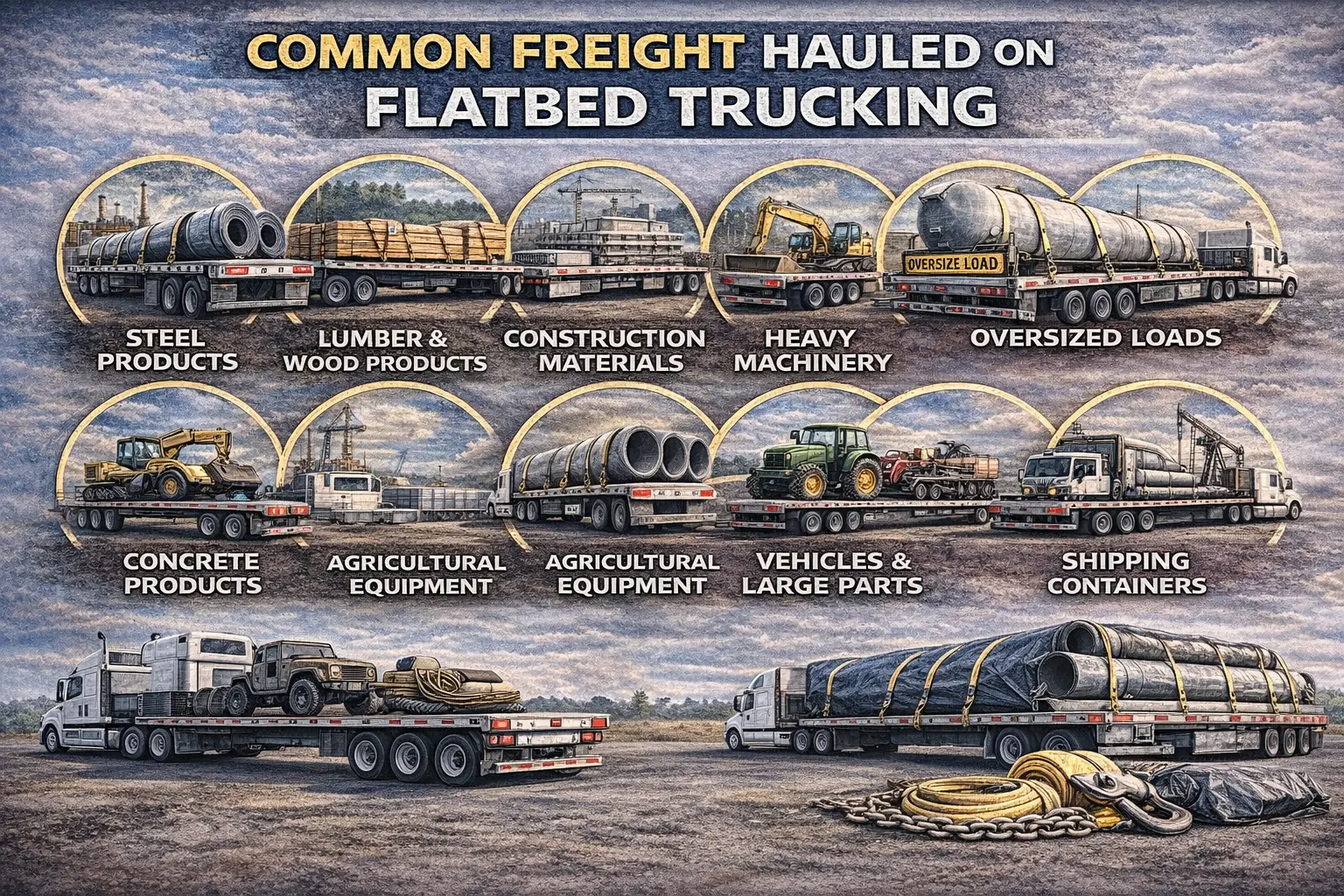
Flatbed trucks are common in the trucking industry for carrying heavy, large, or oddly shaped items that can’t be accommodated in regular enclosed trailers. Since they have no walls or roof, you can operate loading and unloading on the sides or top, and this is useful for many jobs.
Below are the most common things that are hauled on flatbeds, explained in a simple way.
Steel and Metal Products
One of the most common loads for flatbeds, because it is heavy and big, is steel.
Common steel loads include:
- Steel coils
- Steel beams and girders
- Pipes and tubes
- Rebar
- Sheet metal
These loads typically require the use of chains, as well as binders and edge protection, in order to remain secure.
Lumber and Wood Products
Flatbeds are widely used in the construction process to transport wood.
Common lumber loads:
- Bundles of wood
- Plywood sheets
- OSB panels
- Timber
- Treated wood
These loads are often covered with tarps to keep them dry.
Construction Materials
Many construction items are delivered directly to locations with flatbeds.
Examples:
- Drywall
- Roofing materials
- Insulation
- Scaffolding
- Structural parts
Flatbeds, when a dock isn’t available, are easy to unload from the side.
Heavy Machinery and Equipment
Large machines don’t fit in regular trailers, so flatbeds are necessary.
Typical machinery that is moved:
- Forklifts
- Skid steers
- Bulldozers
- Generators
- Industrial compressors
If the machine is very big, then a special flat bed may be used.
Oversized and Over-Dimensional Freight
Flatbeds are used for loads that are bigger than the legal size limits.
Examples:
- Large tanks
- Prefabricated buildings
- Wind turbine parts
- Industrial equipment
These types of loads often require special permits as well as a planned route.
Concrete Products and Masonry Products
Concrete items are heavy and not flexible, so flatbeds are preferred.
Common concrete loads:
- Concrete pipes
- Precast panels
- Barriers
- Utility vaults
- Blocks
Weight has to be properly spread out for safety.
Agricultural Equipment and Supplies
Flatbeds are typical of farming.
Typical farm loads:
- Tractors
- Harvesters
- Plows
- Irrigation pipes
- Large farm parts
These loads are frequently delivered to rural areas where it is not easy to unload them.
Vehicle and Large Vehicle Part
Some cars and parts are transported using flatbeds.
Examples:
- Commercial vehicles
- Military vehicles
- Vehicle frames
- Large engines
- Axles
Flatbeds allow you to use a crane or a ramp once required.
Shipping Containers
Flatbeds, at times, shift containers short distances.
Common uses:
- From port to yard
- To a construction site
- Temporary delivery
Containers should be locked and secured.
Equipment used by oilfields and energy
The energy sector is very dependent on flatbeds.
Common oilfield loads:
- Drilling gear
- Pipes and casings
- Pumps
- Storage tanks
- Energy parts
These are often heavy loads that require experienced drivers.
Flatbeds: Why They Are Used for These Loads
Flatbeds are then used because they:
- Permit loading from the top and side
- Handle very large freight
- Support heavyweight
- Fit job‑site deliveries
They are such a good multi-purpose tool that they are necessary across many industries.
Conclusion
Flatbed trucks are used to haul some of the toughest and most important cargo in transportation. From steel to wood, heavy machines and heavy equipment, and heavy gear, there’s one machine that adds the flexibility to move heavy loads that other trailers can’t move: the flatbed.
Knowing the common Flatbed Freight helps drivers, dispatchers, and logistics workers to plan better in terms of safety and efficiency of shipment.
👉 Contact Triumph Fleet Services at www.TriumphFleetServices.com or call us at [+1 (682)900-3356]