Artificial intelligence would power load-matching algorithms, which would be the future of dispatch. These algorithms would offer real-time matching, shorter search times, and optimization based on data. However, as the trucking market moves into 2025, a countertrend is starting to show up. Owner-operators and small fleets are increasingly choosing human dispatchers over fully automated dispatch services, according to data and feedback from the industry. This change doesn’t mean that technology is bad; it’s a smart way to deal with the fact that algorithms can’t handle the complicated, relational, and changing nature of freight logistics.
In 2026, owner-operators who are looking at dispatch services will have to choose between algorithmic load apps and human dispatch support. This choice will have a direct effect on their weekly revenue, detention risk, and deadhead miles.
If you’re sick of leaving money on the table and want a partner from a professional dispatch service who fights for your rates and plans your miles, this is a smart choice.
The Efficiency Paradox: Data vs. Context
Automated load-matching platforms work with structured data like the origin, destination, type of equipment, rate, and time. Their main job is to find the best balance between speed and volume. The Transportation Intermediaries Association (TIA) said in a report from 2024 that digital freight matching has cut the time it takes to find a load by an average of 34% for users. The same report, though, says that user satisfaction goes down when things other than basic matching, like the risk of detention, the reliability of the broker, or the familiarity of the lane, come into play.
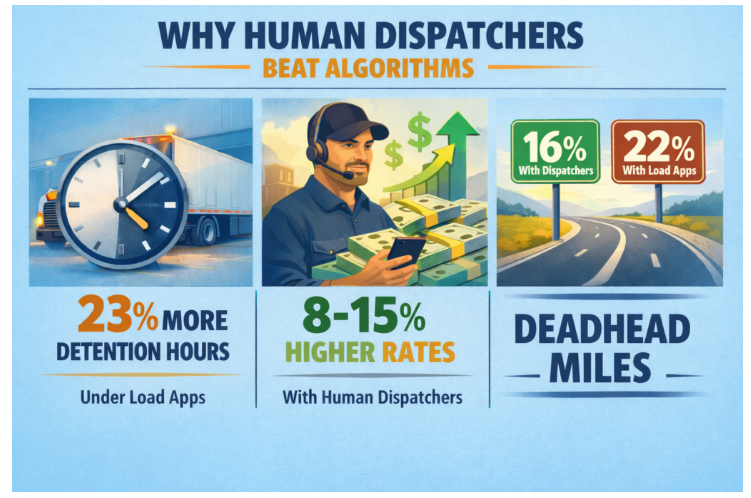
The restriction is contextual. Algorithms don’t have the industry experience they need to make sense of unstructured variables. A study in the Journal of Transportation Management (Fall 2024) found that carriers who used algorithmic dispatch had 23% more unexpected detention hours than those who used human-dispatched services. This was because the system couldn’t check the history of shipper behavior. Human dispatchers use their deep knowledge of lanes and professional networks to avoid expensive delays, which directly leads to better asset use and lower operational risk.
Negotiation and Rate Integrity: The Human Advantage
Negotiating rates is still a process that is mostly based on relationships. Algorithms can match a carrier to a posted rate, but they can’t do the back-and-forth that makes freight pricing fascinating. According to DAT Freight & Analytics, loads booked through human-dispatched services in the fourth quarter of 2024 got line-haul rates that were 8–15% higher on average than those booked through automated spot market platforms for the same lanes.
This difference is due to people’s ability to advocate for themselves and manage relationships. A dispatcher can use long-term relationships with brokers, look at past performance, and negotiate accessibility based on the current situation. This human layer of checking and negotiating is the main way to protect yourself from freight broker scams.
On the other hand, algorithmic systems often see rates as fixed inputs and put speed of matching ahead of rate optimization.
This difference has a direct effect on the profits of owner-operators. The American Trucking Associations’ Independent Contractor Committee’s 2025 Owner-Operator Profitability Report said that consistent rate negotiation was the second most important factor (after fuel costs) in making a steady income. Human-dispatched carriers said their rates were more stable.
Crisis Management and Adaptive Logic
Unpredictability is a big part of the freight business. Things like mechanical failures, bad weather, changes in regulations, and sudden changes in the market can all happen. Algorithms work based on set logic paths and have trouble handling real anomalies. For example, the Federal Motor Carrier Safety Administration (FMCSA) said that weather-related problems rose by 17% in 2024. In these situations, algorithmic systems often don’t have the procedural flexibility to change schedules or reroute loads on their own.
People who work as dispatchers are very good at solving problems in new ways. They act as real-time crisis managers, talking to brokers, changing schedules, and keeping problems from getting worse. This ability not only protects income, but it also keeps the relationship between the carrier and the broker strong. A 2025 survey by Commercial Carrier Journal found that 89% of small fleet owners said having a person to talk to during a logistical crisis was “critical” or “very important” to keeping their business going.
Strategic Routing and Deadhead Reduction
One of the most measurable benefits of human dispatch is that it helps with strategic routing and cutting down on deadhead time. Most algorithms investigate how to make single-load operations more efficient, not multi-leg operations. The 2025 National Private Truck Council Benchmarking Report found that carriers who only used load boards had an average of 22% deadhead miles, while those who used dedicated dispatchers had an average of 16%.
Human dispatchers use continuous trip planning to make round trips and multi-load sequences that keep trucks making money. To use this method, you need to know about seasonal freight flows, regional economic activity, and capacity trends. You can’t just scrape data to get this information. By cutting down on empty miles, dispatchers directly deal with one of trucking’s biggest controllable costs, which immediately boosts the carrier’s bottom line.
This is why a lot of owner-operators who start out using load-matching apps end up switching to structured dispatch services that focus on making money, planning lanes, and screening brokers, not just matching loads quickly.
The Partnership Model: Beyond Transactional Efficiency
The operational model may be the most important difference. Algorithmic platforms make transactions more efficient by letting you pay for a load. Human dispatchers often work as strategic partners, making sure that their success is in line with the carrier’s long-term growth. They learn the carrier’s preferences, schedule, and financial goals, then devise a business plan.
This partnership helps businesses stay stable. An owner-operator can do well in this kind of relationship, as one driver showed when he changed his one-truck business. A 2025 FreightWaves study found that owner-operators who had been working with the same dispatcher for more than a year had 31% higher year-over-year revenue retention than those who switched between digital platforms often. The relational continuity leads to more consistent loads, better relationships with brokers, and cash flow that is easier to predict.
Beyond the App
The future of dispatch is not a choice between people and algorithms; instead, it is a combination of the two, with technology taking care of administrative tasks and people making strategic decisions. As the market in 2025 deals with changing rules, changing economies, and changing capacity, the value of experienced, relational dispatch is being rethought and raised.
For carriers who want to build a successful, long-term business, the human element is still important. It shows the difference between reacting to the market and planning how to move through it.
👉 Contact Triumph Fleet Services at www.TriumphFleetServices.com or call us at [+1 (682)900-3356]